What is a capability statement? Format, what to include and a sample
A capability statement is a one-page summary of what your company does, written for government buyers, prime contractors and procurement teams. Here's what goes on one, how to format it, and a sample for a made-up company.
What a capability statement is for
It's a short marketing document about your company. Buyers use it to decide quickly whether you can do the work they need. You'll use it when you introduce your company to an agency or a prime contractor, register as a vendor, or follow up after meeting a buyer.
The guides we checked from government small business programs list the same five parts and give the same advice: keep it short, and make it about the buyer.
What goes on a capability statement
- Core competencies. The work you do best, tied to what this buyer needs. Not everything you can do.
- Past performance. Similar jobs, most relevant first: work for the same or similar agencies, then other government work, then commercial clients. Leave out work that doesn't relate to the buyer.
- Differentiators. What sets you apart, such as your crews, equipment, facilities or response time, and why it matters to this buyer.
- Company data. The codes and facts buyers use to check that you're eligible. More on these below.
- Contact information. A real person's name, phone and email, plus your website. Not a generic info@ address.
Company data: the codes buyers look for
- UEI (Unique Entity ID). The ID that SAM.gov generates for your business. It replaced the DUNS number as the government's identifier on April 4, 2022.
- CAGE code. For businesses in the U.S., the Defense Logistics Agency assigns one as part of SAM.gov registration.
- NAICS codes. The industry codes for your work. List the numbers without long descriptions, and keep to the ones that matter to this buyer. One guide we checked suggests fewer than 10. You can look codes up on the Census Bureau's NAICS page.
- Certifications and set-asides. Only the ones you hold, such as 8(a), HUBZone, woman-owned (WOSB) or service-disabled veteran-owned (SDVOSB).
- Contract vehicles. A GSA Schedule or other contracts that buyers can order through, if you have them.
- The basics. Year founded, size and service area, plus licenses, bonding or insurance where buyers in your field expect to see them.
Capability statement format
- One page. One side if you can. Use the back only if you truly need it.
- Title it "Capability Statement" at the top, with your company name and logo.
- Short sentences and bullets, not long paragraphs. Two or three sentences of introduction at most.
- Your brand's logo and colors, so it matches your website and proposals.
- Send it as a PDF named with your company name. Some agencies block Word files, and one guide we checked says to keep the file under 1 MB.
- Tailor it. Make a version for each agency, prime contractor or opportunity, built around what they buy.
A sample capability statement
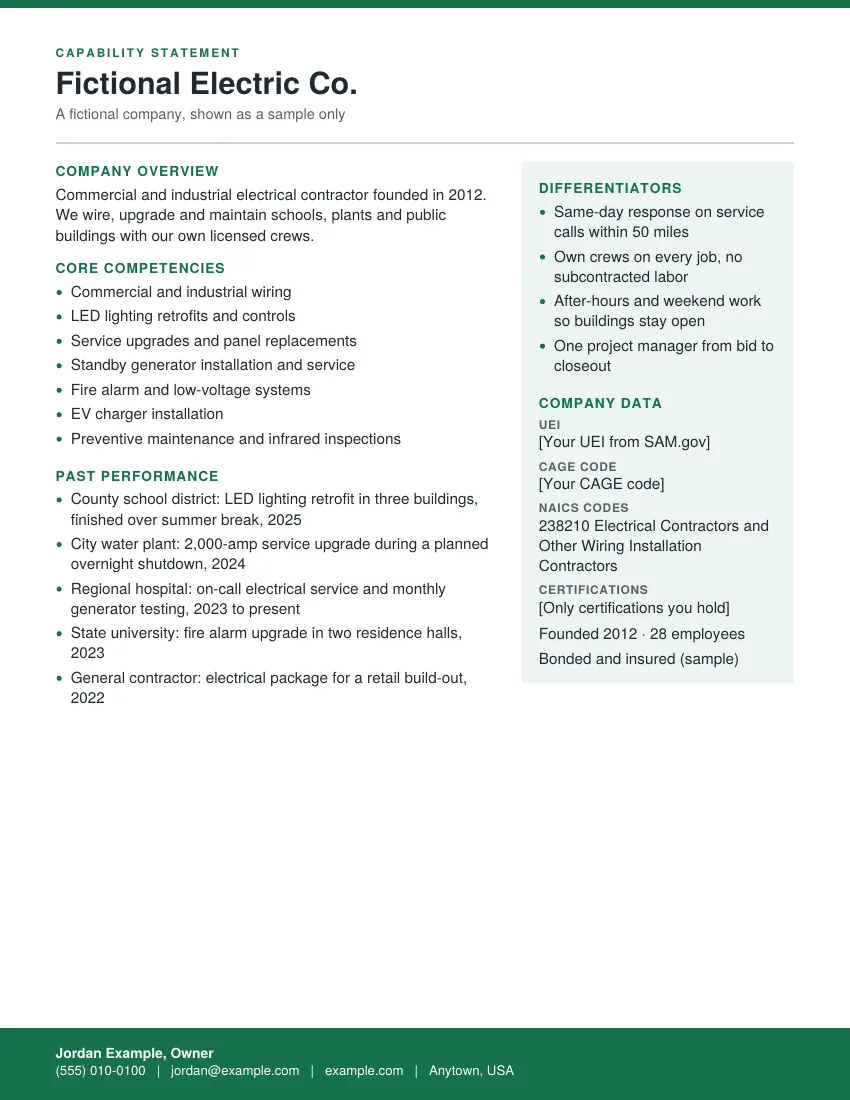
This sample is for a company we made up, Fictional Electric Co. The company, its work history and the contact details are all invented, and the codes in brackets are placeholders for your own.
Capability statements for construction companies
General contractors and owners want to know you can handle the job without adding risk. Along with the five parts, consider showing:
- Your licenses, and your bonding capacity if you're bonded
- Your safety program, with safety figures only if you can back them up
- The types and sizes of projects you've completed, with dates
- The equipment you own and the crews you can put on a job
- The counties or states you work in
For government contractors
- Register in SAM.gov. That's where your UEI comes from, and U.S. businesses get a CAGE code as part of registration.
- Keep your capability statement consistent with your SAM.gov registration: the same name, codes and certifications.
- Put your set-aside certifications where a buyer sees them quickly, and list only the ones you hold.
Common mistakes
- Long paragraphs instead of bullets
- Every project you've ever done, instead of the relevant ones
- Vague claims like "quality service" that don't say why you're the better choice
- A generic info@ email address instead of a person
- Certifications you don't hold, or codes that don't match your SAM.gov registration
- A Word file instead of a PDF
Make yours for free
Our free capability statement builder turns your answers into a one-page PDF right in your browser. There's no login, and nothing you type is saved.
Want it designed? We write and design capability statements for $295, with extra versions for other buyers at $95 each. Want a website to match? The Bid-Ready website plan includes one. If you want help with the bids themselves, see bid and proposal support, built to order for contractors outside the facility services industry.
Sources
- Creating an Effective Capability Statement, a procurement technical assistance center guide published on HUD.gov (PDF)
- Contracting Capability Statement format guide, on the NIH Office of Acquisition Management and Policy website (PDF)
- Unique Entity ID fact sheet, U.S. General Services Administration (PDF)
- FAR 52.204-16, Commercial and Government Entity Code Reporting, Acquisition.gov
- North American Industry Classification System, U.S. Census Bureau
Checked November 2, 2026. This guide is general information, not legal or contracting advice.
Make your capability statement now
Free, no login, and the PDF is made in your browser.